

Businesses collect millions of records every day. Customer databases, online stores, CRM systems, supplier lists, marketing platforms, and analytics tools all contain brand names. Unfortunately, these brand names are often entered in different ways. Even a small spelling difference can create duplicate records, inaccurate reports, and poor customer experiences.
- What Are Brand Name Normalization Rules?
- Why Brand Name Normalization Rules Matter
- How Brand Name Normalization Works
- Collect Raw Data
- Identify Variations
- Apply Transformation Rules
- Convert to Canonical Form
- Store Standardized Data
- Benefits of Brand Name Normalization Rules
- Improved Data Accuracy
- Better Business Intelligence
- Reduced Duplicate Records
- Improved Customer Experience
- Higher Search Performance
- Simplified Data Integration
- Better AI Performance
- Common Problems Caused by Inconsistent Brand Names
- Capitalization Differences
- Punctuation Variations
- Legal Company Suffixes
- Misspellings
- Spacing Issues
- Abbreviations
- Building Your Brand Name Normalization Ruleset
- Step 1: Audit Your Current Data
- Step 2: Define Your Canonical Forms
- Step 3: Build Transformation Rules
- Real-World Examples of Brand Name Normalization Rules
- Example 1: Retail Product Catalog
- Example 2: Electronics Distributor
- Example 3: Fashion Marketplace
- Example 4: Customer Relationship Management (CRM)
- Best Practices for Creating Effective Brand Name Normalization Rules
- Advanced Brand Name Normalization Techniques
- Dictionary-Based Normalization
- Rule-Based Normalization
- Pattern Matching
- Fuzzy Matching
- Machine Learning-Based Normalization
- Industry Use Cases for Brand Name Normalization Rules
- How Automation Improves Brand Name Normalization
- Popular Tools That Support Brand Name Normalization
- Common Mistakes to Avoid
- Using Multiple Official Brand Names
- Ignoring New Brands
- Over-Automating
- Removing Too Much Information
- Failing to Document Rules
- Treating Normalization as a One-Time Project
- How to Measure the Success of Brand Name Normalization Rules
- Duplicate Reduction Rate
- Search Accuracy
- Reporting Consistency
- Customer Satisfaction
- Manual Correction Rate
- Data Quality Score
- The Future of Brand Name Normalization Rules
- Greater Use of Artificial Intelligence
- Real-Time Data Processing
- Global Brand Recognition
- Integration Across Business Platforms
- Smarter Data Governance
- Conclusion
- Frequently Asked Questions (FAQs)
- What is the main purpose of brand name normalization rules?
- Are brand name normalization rules only useful for large companies?
- What is a canonical brand name?
- Can brand name normalization improve SEO?
- How often should normalization rules be reviewed?
- Is brand name normalization the same as data cleaning?
- Can automation completely replace human review?
For example, one database may contain “Nike,” another may list “NIKE,” while a third records “Nike Inc.” Although all three refer to the same company, computers may treat them as different brands unless proper brand name normalization rules are applied.
This is where brand name normalization rules become essential.
Brand name normalization rules create a consistent way to write, store, and process brand names across every business system. Instead of allowing hundreds of different variations, every version is transformed into one approved standard, often called the canonical form.
For organizations that depend on accurate data, these rules improve reporting, reduce duplicate records, strengthen search results, simplify data analysis, and improve customer trust.
Whether you manage an online store, maintain a CRM database, develop software, analyze customer data, or oversee enterprise information systems, understanding brand name normalization rules is becoming an important skill.
This guide explains everything you need to know—from basic concepts to advanced implementation strategies—using clear examples and practical advice that businesses can apply immediately.
What Are Brand Name Normalization Rules?
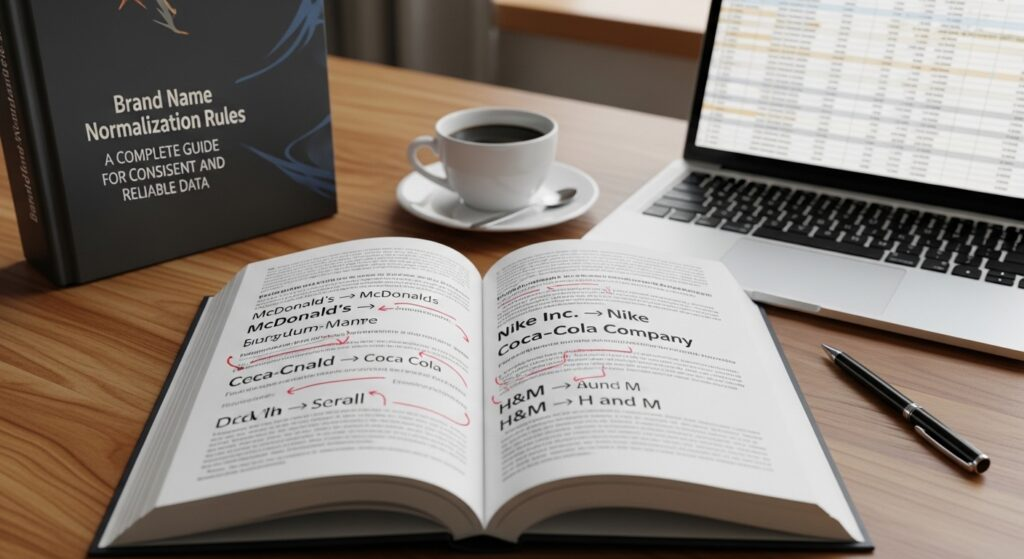
Brand name normalization rules are a set of standardized instructions used to convert different versions of the same brand name into one consistent format.
Instead of allowing multiple spellings, abbreviations, punctuation styles, or capitalization differences, normalization rules automatically transform every variation into one approved version.
For example:
Original Data
- NIKE
- Nike
- nike
- Nike Inc.
- Nike, Inc
- NIKE INC.
Normalized Result
- Nike
Each variation refers to the same company, but after normalization, only one official version remains.
These rules are commonly used in:
- Customer Relationship Management (CRM)
- Product Information Management (PIM)
- Enterprise Resource Planning (ERP)
- Data Warehouses
- E-commerce Platforms
- Marketing Databases
- Inventory Systems
- Business Intelligence Dashboards
- Search Engines
- AI Data Pipelines
The primary goal is consistency.
Consistency makes data easier to search, analyze, compare, and maintain.
Why Brand Name Normalization Rules Matter
Also Read:OncePik: The Complete Guide to Smart Picks for Tech, Lifestyle, Trends & Home Improvement
Many organizations underestimate how much inconsistent brand names affect business operations.
Small differences often create much larger problems.
Imagine an online retailer selling products from Apple.
Their product database includes:
- Apple
- APPLE
- Apple Inc.
- Apple Computer
- Apple, Inc.
- Apple Incorporated
When inventory reports are generated, the software may believe there are five different brands.
This leads to:
- Incorrect sales reports
- Duplicate inventory
- Poor forecasting
- Customer confusion
- Broken search filters
- Lower data quality
Brand name normalization rules eliminate these issues by ensuring every record follows the same naming standard.
This improves both operational efficiency and decision-making.
How Brand Name Normalization Works
Normalization is not simply changing uppercase letters to lowercase.
It is a structured process consisting of several transformation stages.
A typical workflow includes:
Collect Raw Data
Brand names enter systems from:
- Customer forms
- Supplier databases
- Imports
- APIs
- Excel spreadsheets
- Product catalogs
- Third-party marketplaces
At this stage, inconsistencies naturally occur.
Identify Variations
The next step is finding all different versions of each brand.
For example:
Microsoft
Possible variations include:
- Microsoft
- MICROSOFT
- Microsoft Corp.
- MSFT
- Microsoft Corporation
All refer to one organization.
Apply Transformation Rules
Each variation passes through predefined normalization rules.
Rules may include:
- Remove unnecessary punctuation
- Standardize capitalization
- Remove legal suffixes
- Expand abbreviations
- Replace common misspellings
- Remove duplicate spaces
- Standardize symbols
Convert to Canonical Form
Every variation is replaced with one approved name.
Example
Input
- coca cola
- Coca-Cola
- Coca Cola Company
- Coca-Cola Co.
Output
- Coca-Cola
This becomes the canonical form.
Store Standardized Data
Only normalized values are saved.
Future reports become significantly more accurate because all records use identical names.
Benefits of Brand Name Normalization Rules
Organizations of every size benefit from standardized brand data.
Improved Data Accuracy
When every record follows one naming standard, databases become cleaner and more reliable.
Managers can trust reports without manually fixing duplicate brand names.
Better Business Intelligence
Analytics tools depend on clean data.
Normalized brand names improve:
- Sales reports
- Revenue analysis
- Market trends
- Customer segmentation
- Inventory planning
Reliable data leads to better business decisions.
Reduced Duplicate Records
Duplicate brand names waste storage and create confusion.
Normalization combines multiple versions into one consistent identity.
Improved Customer Experience
Customers expect search functions to work properly.
Without normalization:
Searching for
“Nike”
may not display products labeled
“NIKE Inc.”
Normalization solves this issue.
Customers find products faster.
Higher Search Performance
Search engines inside websites perform better when brand names follow consistent formatting.
Users receive accurate results regardless of capitalization or punctuation.
Simplified Data Integration
Modern businesses connect multiple software systems.
Different systems often use different naming formats.
Brand name normalization rules ensure all systems communicate using identical values.
Better AI Performance
Artificial intelligence depends heavily on clean datasets.
Machine learning models perform better when brand names are standardized.
Normalization reduces data noise and improves prediction accuracy.
Common Problems Caused by Inconsistent Brand Names
Many organizations experience the same challenges.
Capitalization Differences
Examples
- sony
- SONY
- Sony
Without normalization, software may treat them differently.
Punctuation Variations
Examples
- H&M
- H and M
- H & M
Although humans recognize them as the same brand, computers often do not.
Legal Company Suffixes
Examples
- Dell
- Dell Inc.
- Dell Incorporated
These usually represent the same organization.
Normalization removes unnecessary legal suffixes when appropriate.
Misspellings
Examples
- Addidas
- Adidas
- Adiddas
Misspelled entries reduce data quality.
Rule-based correction improves consistency.
Spacing Issues
Examples
- CocaCola
- Coca Cola
- Coca-Cola
Spacing inconsistencies are common in imported datasets.
Abbreviations
Examples
- IBM
- International Business Machines
Businesses must decide whether the abbreviation or full name becomes the canonical version.
Building Your Brand Name Normalization Ruleset
Every successful normalization project begins with a structured ruleset.
Rather than fixing problems one at a time, organizations create standardized rules that apply automatically.
The following framework is widely used across enterprise data management projects.
Step 1: Audit Your Current Data
Before creating any normalization rules, understand the condition of your existing data.
A complete audit identifies every inconsistency already present.
Review data from all sources, including:
- CRM systems
- Sales platforms
- ERP software
- Marketing databases
- Vendor records
- Product catalogs
- Customer forms
Look for:
- Duplicate brands
- Misspellings
- Capitalization differences
- Extra punctuation
- Legal suffixes
- Outdated company names
- Merged brands
- Acquired companies
A simple spreadsheet often reveals hundreds of duplicate entries.
Example
| Original Entry | Issue |
| NIKE | Capitalization |
| Nike Inc. | Legal suffix |
| Nike | Correct |
| nike | Lowercase |
| Nkie | Misspelling |
An audit provides the foundation for every future normalization rule.
Step 2: Define Your Canonical Forms
The canonical form is the official version that every variation should become.
This decision should be documented clearly.
Example
Approved Name
Nike
Rejected Versions
- NIKE
- nike
- Nike Inc.
- Nike Incorporated
Every transformation rule points toward the canonical version.
Good canonical forms are:
- Easy to read
- Widely recognized
- Consistent with official branding
- Stable over time
- Simple to maintain
Avoid creating multiple accepted versions.
One brand should have one official name.
Step 3: Build Transformation Rules
Now create the rules that convert inconsistent data into the approved format.
These rules should be predictable and repeatable.
Common transformation rules include:
Rule 1: Standardize Capitalization
Convert:
- NIKE
- nike
- NiKe
Into:
Nike
Rule 2: Remove Extra Spaces
Convert:
” Nike “
Into:
Nike
Rule 3: Remove Duplicate Spaces
Convert:
“Procter & Gamble”
Into:
“Procter & Gamble”
Rule 4: Standardize Symbols
Convert:
- and
- &
Into one approved format where appropriate.
Example:
H and M
becomes
H&M
Rule 5: Remove Legal Suffixes
Transform:
- Inc.
- LLC
- Ltd.
- Limited
- Corporation
- Corp.
When business requirements allow.
Example
Microsoft Corporation
becomes
Microsoft
Rule 6: Correct Known Misspellings
Example
Adiddas
becomes
Adidas
Building a dictionary of common spelling mistakes greatly improves accuracy.
Also Read:Delta Fitness Authority: The Complete Guide to Fitness, Nutrition, Equipment & Membership
Rule 7: Normalize Abbreviations
Choose one official version.
Example
International Business Machines
becomes
IBM
or
IBM
becomes
International Business Machines
The choice depends on organizational standards.
Real-World Examples of Brand Name Normalization Rules
Understanding theory is helpful, but seeing real examples makes the concept much easier to apply.
Below are common scenarios businesses face every day.
Example 1: Retail Product Catalog
Raw Data:
- Nike
- NIKE
- Nike Inc.
- nike
- Nike, Inc.
Normalized Output:
- Nike
Result:
Product pages, inventory reports, and search filters all reference the same brand, eliminating duplicate listings.
Example 2: Electronics Distributor
Raw Data:
- HP
- Hewlett Packard
- Hewlett-Packard
- Hewlett Packard Inc.
Normalized Output:
- HP
Result:
Sales analytics become more accurate because all purchases are grouped under one official brand name.
Example 3: Fashion Marketplace
Raw Data:
- H&M
- H and M
- H & M
- HM
Normalized Output:
- H&M
Result:
Customers can search using different variations and still find every relevant product.
Example 4: Customer Relationship Management (CRM)
Raw Data:
- Microsoft
- MICROSOFT
- Microsoft Corp.
- Microsoft Corporation
Normalized Output:
- Microsoft
Result:
Duplicate customer records decrease, improving marketing campaigns and reporting accuracy.
Best Practices for Creating Effective Brand Name Normalization Rules
Successful normalization is not just about replacing text. It requires a structured strategy that can grow with your business.
Follow these best practices:
- Create one official naming standard for every brand.
- Document every normalization rule so all teams use the same guidelines.
- Review new brand names regularly to keep your rules current.
- Test rules on a sample dataset before applying them to production systems.
- Keep historical records when needed for auditing purposes.
- Automate repetitive transformations whenever possible.
- Monitor data quality over time instead of treating normalization as a one-time project.
- Collaborate with marketing, legal, data management, and IT teams when defining canonical forms.
A well-maintained ruleset improves accuracy for years and reduces the need for manual data cleanup.
Advanced Brand Name Normalization Techniques
As businesses grow, simple formatting rules are no longer enough. Large organizations often manage millions of records coming from hundreds of sources. In these situations, advanced brand name normalization rules become essential for maintaining high-quality data.
These techniques help identify hidden duplicates, improve automation, and ensure long-term consistency.
Dictionary-Based Normalization
A dictionary-based approach uses a predefined list of approved brand names and their known variations.
For example:
Approved Brand
Nike
Known Variations
- NIKE
- Nike Inc.
- Nike Incorporated
- Nike, Inc.
- nike
Whenever the system finds one of these variations, it automatically replaces it with the approved version.
This approach is simple, accurate, and easy to maintain for well-known brands.
Rule-Based Normalization
Rule-based normalization applies specific transformation rules to every record.
Common rules include:
- Remove extra spaces
- Convert to title case
- Remove legal suffixes
- Replace special characters
- Standardize punctuation
- Correct common spelling mistakes
This method works well when the data follows predictable patterns.
Pattern Matching
Some variations follow recognizable patterns.
For example:
- Company Name Inc.
- Company Name LLC
- Company Name Ltd.
A pattern-matching rule can remove these suffixes automatically.
This reduces manual work while improving consistency.
Fuzzy Matching
Sometimes two names look different but represent the same brand.
Examples include:
- Addidas
- Adidas
or
- Microsft
- Microsoft
Fuzzy matching compares the similarity between words and identifies likely matches.
Because fuzzy matching is not perfect, businesses often review suggested matches before applying them automatically.
Machine Learning-Based Normalization
Modern organizations increasingly use artificial intelligence to identify brand variations.
AI systems learn from historical data and recognize patterns that traditional rules may miss.
For example, an AI model can determine that:
- Google LLC
- Google Inc.
all refer to the same brand, even if the variation has never appeared before.
Although AI is powerful, it performs best when combined with carefully designed brand name normalization rules.
Industry Use Cases for Brand Name Normalization Rules
Almost every industry benefits from standardized brand names.
E-Commerce
Online stores often receive product information from multiple suppliers.
Without normalization, products from the same manufacturer may appear under several different brand names.
Benefits include:
- Better product search
- Cleaner product catalogs
- Improved inventory management
- More accurate sales reports
Healthcare
Healthcare organizations manage medical equipment, pharmaceutical brands, and supplier databases.
Standardized brand names help prevent duplicate records and improve purchasing accuracy.
Financial Services
Banks and financial institutions analyze transactions involving thousands of companies.
Normalization improves:
- Fraud detection
- Risk analysis
- Customer reporting
- Regulatory compliance
Marketing
Marketing teams collect customer information from websites, social media, email campaigns, and advertising platforms.
Brand normalization ensures consistent reporting across all channels.
Business Intelligence
Executives rely on accurate dashboards.
When every brand follows one naming standard, reports become much more reliable.
This supports better strategic decisions.
Supply Chain Management
Suppliers often use different naming conventions for the same manufacturer.
Normalization simplifies:
- Vendor management
- Purchase orders
- Inventory tracking
- Supplier analysis
How Automation Improves Brand Name Normalization
Manual normalization works for small datasets.
However, organizations managing thousands or millions of records need automation.
Automated normalization provides several advantages.
Faster Processing
Large databases can be standardized within minutes instead of weeks.
Lower Costs
Automation reduces manual labor and minimizes repetitive work.
Improved Consistency
Unlike humans, automated systems apply the same rules every time.
Reduced Errors
Automation decreases typing mistakes and inconsistent decisions.
Continuous Data Quality
Instead of cleaning data once each year, automated systems normalize records as they enter the database.
This keeps information clean from the beginning.
Popular Tools That Support Brand Name Normalization
Many software platforms include features that help businesses standardize brand names.
Common categories include:
- Customer Relationship Management (CRM) systems
- Product Information Management (PIM) platforms
- Master Data Management (MDM) software
- Data Quality tools
- Extract, Transform, Load (ETL) platforms
- Spreadsheet automation tools
- SQL-based data transformation tools
- Python data processing libraries
- Cloud data integration platforms
- Artificial intelligence data quality solutions
The best tool depends on your organization’s size, budget, and technical requirements. Regardless of the software used, the effectiveness of the system depends on well-designed brand name normalization rules.
Common Mistakes to Avoid
Many normalization projects fail because organizations overlook important details.
Avoid these common mistakes.
Using Multiple Official Brand Names
Each brand should have one approved canonical form.
Allowing several “official” versions defeats the purpose of normalization.
Ignoring New Brands
Markets constantly evolve.
Update your rules whenever new brands enter your system.
Over-Automating
Automation is valuable, but some decisions require human review.
Rare brand names and unusual spellings should be verified before changes are applied.
Removing Too Much Information
Sometimes legal suffixes are important.
For example, two companies with similar names may be legally different entities.
Always consider your business requirements before removing information.
Failing to Document Rules
If normalization rules are not documented, different teams may apply different standards.
Documentation keeps everyone aligned.
Treating Normalization as a One-Time Project
Data quality requires ongoing maintenance.
Regular reviews help keep your rules accurate as businesses, products, and markets change.
How to Measure the Success of Brand Name Normalization Rules
After implementing normalization, organizations should monitor performance using measurable indicators.
Useful metrics include:
Duplicate Reduction Rate
Measure how many duplicate brand records were removed.
A lower duplicate rate indicates better data quality.
Search Accuracy
Evaluate whether users find the correct products or records regardless of how they search for a brand.
Reporting Consistency
Check whether dashboards and reports now group brand information correctly.
Customer Satisfaction
Improved search functionality and cleaner product listings often lead to a better customer experience.
Manual Correction Rate
Track how often employees still need to manually fix brand names.
Successful normalization significantly reduces manual edits.
Data Quality Score
Many organizations use internal data quality metrics to monitor improvements over time.
Higher scores indicate more reliable information across business systems.
The Future of Brand Name Normalization Rules
The importance of clean data continues to grow as businesses adopt artificial intelligence, cloud computing, and advanced analytics.
Several trends are shaping the future of brand name normalization.
Greater Use of Artificial Intelligence
AI models will continue improving their ability to recognize brand variations automatically.
This will reduce manual work while increasing accuracy.
Real-Time Data Processing
Instead of cleaning data after it is collected, organizations will normalize information instantly as it enters their systems.
Also Read:Inomyalgia: Symptoms, Causes, Treatment, Diagnosis, and Pain Relief Guide
Global Brand Recognition
International businesses manage data in multiple languages and regions.
Future normalization systems will better support multilingual brand names while preserving consistency.
Integration Across Business Platforms
Normalization rules will increasingly work across CRM systems, ERP platforms, marketing software, analytics tools, and cloud databases to provide a single source of truth.
Smarter Data Governance
Organizations are placing greater emphasis on data governance, ensuring that brand information remains accurate, secure, and compliant with internal policies and industry regulations.
Conclusion
Consistent brand information is the foundation of reliable business data. Without standardized naming conventions, organizations face duplicate records, inaccurate reports, inefficient workflows, and poor customer experiences.
Brand name normalization rules solve these challenges by converting different versions of the same brand into one approved, consistent format. Whether the differences involve capitalization, punctuation, abbreviations, legal suffixes, or spelling variations, a well-designed normalization strategy ensures that every system works with clean and reliable data.
Building an effective ruleset starts with auditing existing data, defining canonical brand names, and creating clear transformation rules. As organizations grow, advanced techniques such as dictionary-based matching, fuzzy matching, machine learning, and automated data processing provide even greater accuracy and efficiency.
Businesses that invest in strong brand name normalization rules gain more than cleaner databases. They improve reporting, strengthen analytics, simplify integrations, enhance customer experiences, and create a solid foundation for artificial intelligence and future digital transformation initiatives.
Rather than viewing normalization as a one-time cleanup task, organizations should treat it as an ongoing part of data governance. Regular updates, continuous monitoring, and collaboration across departments help maintain high-quality brand information that supports smarter decisions and sustainable business growth.
By following the strategies and best practices outlined in this guide, businesses of all sizes can build reliable brand data systems that remain accurate, scalable, and ready for the future.
Frequently Asked Questions (FAQs)
What is the main purpose of brand name normalization rules?
The primary purpose is to standardize different versions of the same brand name into one consistent format, improving data quality, reporting, and search accuracy.
Are brand name normalization rules only useful for large companies?
No. Small businesses, startups, and enterprise organizations all benefit from cleaner and more consistent brand data.
What is a canonical brand name?
A canonical brand name is the single approved version that all variations are converted into during the normalization process.
Can brand name normalization improve SEO?
Yes. Consistent brand names across product pages, databases, and website content help improve user experience, internal search performance, and overall data consistency, which can indirectly support SEO.
How often should normalization rules be reviewed?
Organizations should review their rules regularly, especially when adding new products, entering new markets, or integrating new data sources.
Is brand name normalization the same as data cleaning?
No. Data cleaning is a broader process that includes correcting errors, removing duplicates, and improving data quality. Brand name normalization focuses specifically on standardizing brand names.
Can automation completely replace human review?
Not always. Automated systems handle most routine transformations, but unusual cases and uncertain matches often require human validation.